


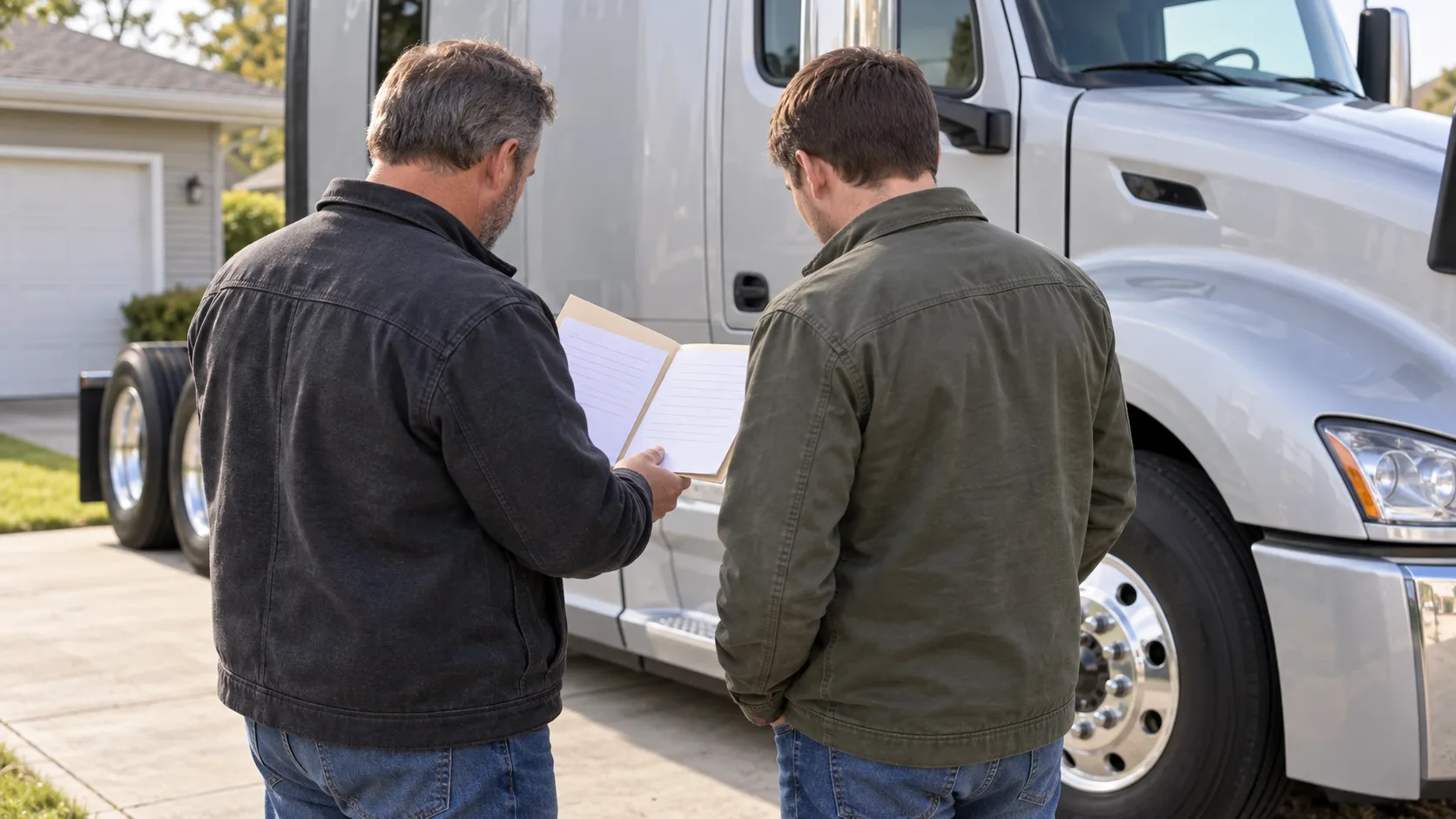
You need five things from the deal itself: a title in the seller’s name, a written payoff from the lienholder if there is a loan on the truck, a signed bill of sale, the seller’s photo ID, and a VIN you have read off the truck. On top of those come your own business file and proof of insurance. When an owner-to-owner purchase stalls, it is almost always because one of these showed up late.
None of this is exotic. It is the closing work a dealership would normally do for you, and private party truck financing is built around it. Here is the list, in the order it usually matters.
The title
The title is the document everything else is checked against. Ask the seller for a photo of the front and the back before you agree on anything else, and check three things:
- The name on the title is the name of the person or company selling the truck
- The VIN on the title matches the VIN on the truck itself, not only the one in the advertisement
- Any brand or notation on the title is understood by both sides, so it does not surprise anyone at closing
A title that is not in the seller’s name is the one problem that should stop the deal until it is fixed. Most items on this list can be sorted out with a phone call. A title in someone else’s name is different: the seller has to resolve that first.
The payoff letter, if there is a loan on the truck
A truck sold by its owner often still carries a loan. That does not end the deal, but it changes the order of events: the lienholder is paid first, and the title moves only after that.
The document that makes this work is a written payoff letter from the lienholder. Ask the seller to request it on day one. It should show who the lienholder is, the amount needed to close the loan, the date through which that amount is good, and where the payment goes. If the closing slips past that date, the figure may need to be refreshed.
In a financed purchase the payoff goes directly to the lienholder at closing, and the seller receives the balance. Once the loan is paid, the lienholder releases its claim on the title. Nobody should hand over cash and hope the old loan gets cleared afterwards.
The bill of sale
A verbal agreement leaves every detail open to argument at closing, so the deal goes on paper. A bill of sale should carry:
- The legal names and addresses of the buyer and the seller
- The date and the agreed price
- The year, make, model and VIN of the truck
- The mileage shown on the odometer on the day of the sale
- Everything that is included — an APU, extra tanks, chains, straps
- Signatures from both sides
Itemizing the extras matters more than it looks. The funding partner releases money against this document, and you need it to show exactly what you bought. If an item is not on the page, it is not part of the sale on paper.
Proof of who is selling and what is being sold
A few checks protect everyone in the deal, and each of them is quick:
- Photo ID that matches the title. The seller shows identification and the name matches the name on the title. If a company owns the truck, the person signing should be able to sign for it.
- The VIN, read off the truck. Compare it with the title, the bill of sale and the advertisement. A mismatch is one of the most common reasons a file comes back with a question.
- Photos, service records and, where it makes sense, an inspection. On an older or higher-mileage unit a lender may ask for these, and getting them from the seller early saves days.
What you bring as the buyer
The seller’s papers are half of the file. The other half is yours, and it is the same short list described in the documents lenders actually want to see:
- Legal entity name exactly as registered, and the EIN
- MC / DOT number, if you run under your own authority
- The last three months of business bank statements, as PDFs from your bank portal
- The VIN and photos of the truck as it stands
- Proof of insurance on the unit before funding
The baseline for equipment financing is an Inc. or an LLC with at least two years of operating history. If the entity is newer than that and already hauls freight, freight factoring is worth a look: approval leans on who owes you, not on how long you have been running.
Where state rules come in
Title transfer, registration, taxes and the exact forms are set by the state, not by the lender. Whether a signature on the title or the bill of sale has to be notarized, and whether the state wants its own bill of sale or other transfer forms, differs from one state to the next. Requirements vary by state; check with your state’s title office before the day of the sale.
If the seller is in a different state from you, say so at the start. Each state has its own transfer rules, and the paperwork has to be prepared for both.
A sensible order of operations
- Day one: photos of the title, front and back; the VIN read off the truck; and a request to the seller for a written payoff if there is a loan
- Before any deposit: a written price, an itemized list of what is included, and your financing options
- Before closing: insurance arranged on the unit and the bill of sale ready for both signatures
Starting the title and payoff work the same day you agree on a price is the cheapest speed-up in a private-party deal. The usual reasons deals drag are covered in what can delay a truck financing approval, and the wider comparison with buying from a dealer is in dealer vs. private-party.
Found a truck in someone’s yard? See how a private-party closing runs or check your options — one application to 40+ lender partners, soft credit pull only, no obligation. Decisions typically come back within 24 hours of a complete application.